What Are the 4 Types of Security? A Simple Guide for Businesses
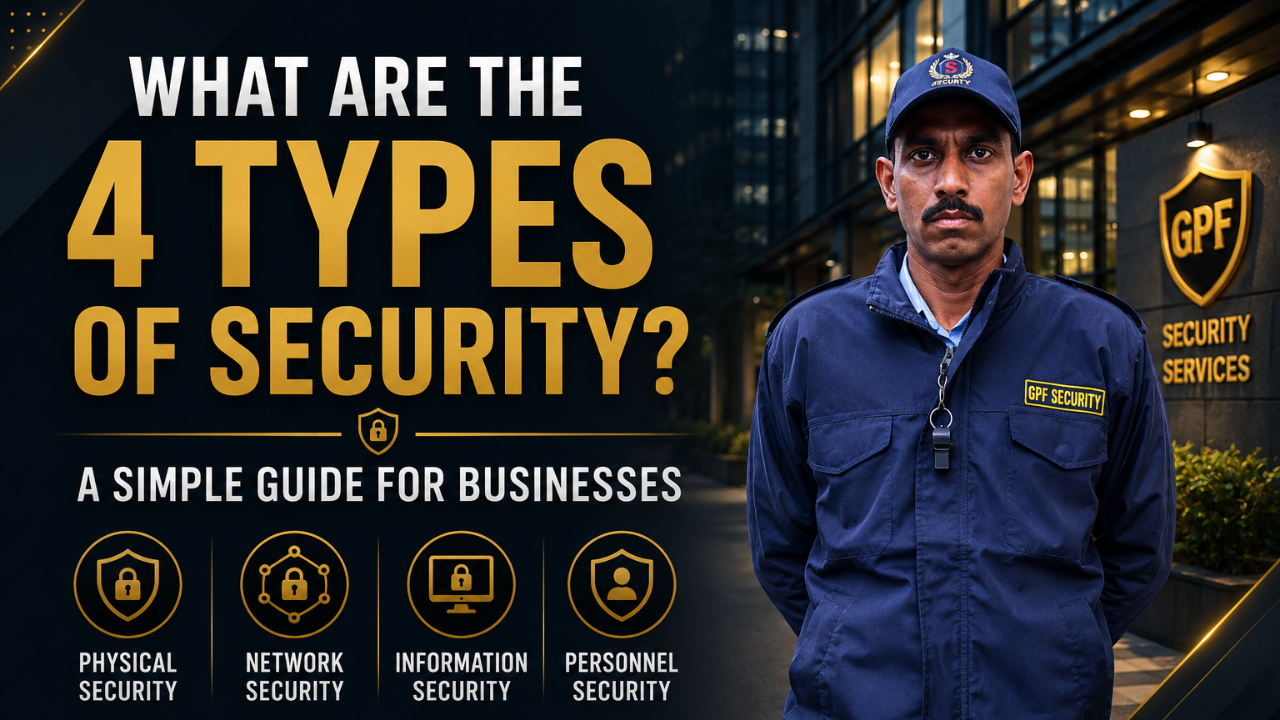
Quick answer: The four main types of security are physical security (guards, CCTV, access control), information security (protecting data and networks), operational security or OPSEC (protecting day-to-day processes and sensitive information), and personnel security (making sure the people you hire are trustworthy). No single type protects you on its own; they work best together.
When most people hear the word "security," they picture a guard at the gate. That is part of it, but only part. Security is really about protecting four things at once: your people, your property, your information, and the way your business runs every day. Threats can come from a thief climbing a wall, a hacker breaking into your network, a leaked document, or even a dishonest hire.
Whether you run a residential society, a corporate office, a hospital, a school, a retail store, or an industrial unit, you need a security plan that covers all of these angles. Below, we break down the four main types of security in plain English, with real examples, so you can see exactly where your own setup is strong and where it might have gaps.
1. Physical Security
Physical security is about protecting people, buildings, equipment, and other physical assets from unauthorised access, theft, vandalism, and damage. It is the first line of defence for any organisation, and usually the most visible one.
Key components of physical security
- Security guards and patrolling
- CCTV surveillance systems
- Access control systems (keycards, smart locks)
- Alarm systems and motion detectors
- Security fencing, gates, and perimeter lighting
- Biometric access
- Visitor management systems
- Emergency exits and fire safety equipment
Why physical security matters
Done well, it prevents theft and property damage, protects employees and visitors, reduces the risk of unauthorised entry, improves everyday workplace safety, and helps your business stay compliant with safety regulations.
Example: A corporate office installs CCTV cameras, deploys trained security guards, and uses biometric access so that only authorised employees can enter the building.
Where GPF fits: This is the layer most businesses hire us for first, guards, CCTV-backed monitoring, access control, and visitor management, delivered as part of our security services in Gurgaon. If you are weighing cameras against guards, our comparison of CCTV vs security guards is a good next read.
2. Information Security (Cyber Security)
Information security protects your digital information, computer systems, and networks from cyber threats. As businesses rely more and more on technology, keeping sensitive data safe has become just as important as locking the front door.
Key components of information security
- Network security: firewalls, VPNs, and intrusion prevention systems that keep intruders out of internal networks
- Endpoint security: protecting laptops, smartphones, and connected devices
- Data security: encryption, access controls, and data loss prevention
- Antivirus software and regular software updates
- Multi-factor authentication (MFA)
- Secure cloud storage and password management
- Continuous network monitoring
Why information security matters
It prevents data breaches, protects customer information, secures financial records, blocks cyberattacks, and keeps the business running when others are scrambling to recover.
Example: An e-commerce company uses encrypted payment gateways, secure servers, and two-factor authentication to protect customer payment information.
3. Operational Security (OPSEC)
Operational security, usually shortened to OPSEC, is about protecting your day-to-day operations, processes, and confidential information from ending up in the wrong hands. It means identifying what information is sensitive, understanding how it could leak, and putting simple procedures in place to reduce that risk.
Key components of operational security
- Risk assessment
- Clear employee security policies
- Access control based on job roles
- Secure document handling
- Incident response planning
- Monitoring and auditing
- Secure communication methods
Why operational security matters
It reduces operational risks, prevents information leaks, protects the way your business actually works, improves compliance, and strengthens your overall security posture.
Example: A manufacturing company limits access to production plans so that only authorised managers and engineers can view confidential designs.
4. Personnel Security
Personnel security makes sure that the people you let in, employees, contractors, and third-party staff, are trustworthy and qualified to access your facilities, systems, and confidential information. The goal is to reduce risks from insider threats, fraud, negligence, or unauthorised access.
Key components of personnel security
- Employee background verification
- Identity verification
- Security awareness training
- Confidentiality agreements
- Sensible employee monitoring
- Role-based access permissions
- Proper exit procedures when employees leave
Why personnel security matters
It prevents insider threats, protects confidential information, builds a workforce you can trust, reduces workplace risks, and supports regulatory compliance.
Example: Before hiring security personnel, a company runs police verification, employment history checks, and identity verification to confirm reliability.
Where GPF fits: Every guard we deploy goes through police verification, identity checks, and medical screening before their first shift, exactly the kind of personnel security this section describes. You can see how we handle this on our regulatory compliance page.
Why All Four Types of Security Matter Together
Here is the key point: no single type of security protects an organisation on its own. A strong strategy combines physical, information, operational, and personnel security into one connected framework.
Think about a hospital. It might use security guards and CCTV for physical security, protect patient records with cybersecurity, follow strict procedures for handling sensitive medical information, and run background checks on doctors, nurses, and support staff. Remove any one of those layers and a gap opens up.
| Type | Protects | Typical Tools |
|---|---|---|
| Physical Security | People, buildings, equipment | Guards, CCTV, access control, fencing |
| Information Security | Data, systems, networks | Firewalls, encryption, MFA, monitoring |
| Operational Security | Day-to-day processes and secrets | Policies, role-based access, audits |
| Personnel Security | Against insider and hiring risks | Background checks, training, exit procedures |
Benefits of Covering All Four Areas
When physical, information, operational, and personnel security work together, businesses see real, practical gains:
- Safer employees and customers
- Better-protected business assets
- Less theft and fraud
- Fewer successful cyberattacks
- Stronger business continuity
- Greater customer trust
- Easier legal and regulatory compliance
- Lower financial losses
- Stronger overall risk management
Conclusion
The four main types of security, physical, information, operational, and personnel, each tackle a different kind of risk. On their own, each leaves a gap. Together, they form a complete framework that protects your people, property, data, and daily operations. Businesses that invest across all four areas are simply better prepared to prevent threats, respond to emergencies, and keep a safe environment for everyone who walks through the door.
If you are focused on the physical and personnel side, which is where most Gurgaon businesses start, GPF can help you build that layer properly. Learn more about how the pieces fit in our guide on the difference between security services and facility management.
Build a Stronger Security Layer for Your Business
Gurgaon Protection Force provides trained, police-verified guards, CCTV-backed monitoring, access control, and visitor management for offices, societies, hospitals, and industrial sites across Gurgaon, Noida, Faridabad, and Delhi. PSARA licensed and ISO 9001:2015 certified since 2012.
Frequently Asked Questions
What are the four main types of security?
The four main types are physical security (protecting people, buildings, and equipment), information or cyber security (protecting data and networks), operational security or OPSEC (protecting daily processes and confidential information), and personnel security (making sure staff are trustworthy and verified).
What is the difference between physical and personnel security?
Physical security protects tangible assets like buildings, equipment, and people through guards, CCTV, and access control. Personnel security focuses on the people themselves, using background checks, identity verification, and training to reduce insider risks.
Which type of security is most important?
No single type is most important, because each protects against a different risk. A gap in any one area can undermine the others, which is why businesses need physical, information, operational, and personnel security working together.
What is operational security (OPSEC)?
Operational security is the practice of identifying sensitive information about how a business runs, understanding how it could be exposed, and putting procedures in place to protect it, such as role-based access, secure document handling, and audits.
Does a security agency handle all four types of security?
Most security agencies, including GPF, specialise in physical and personnel security, guards, CCTV, access control, and verified staff. Information and operational security are usually handled with IT and internal policy teams, though a good agency will coordinate with them.