
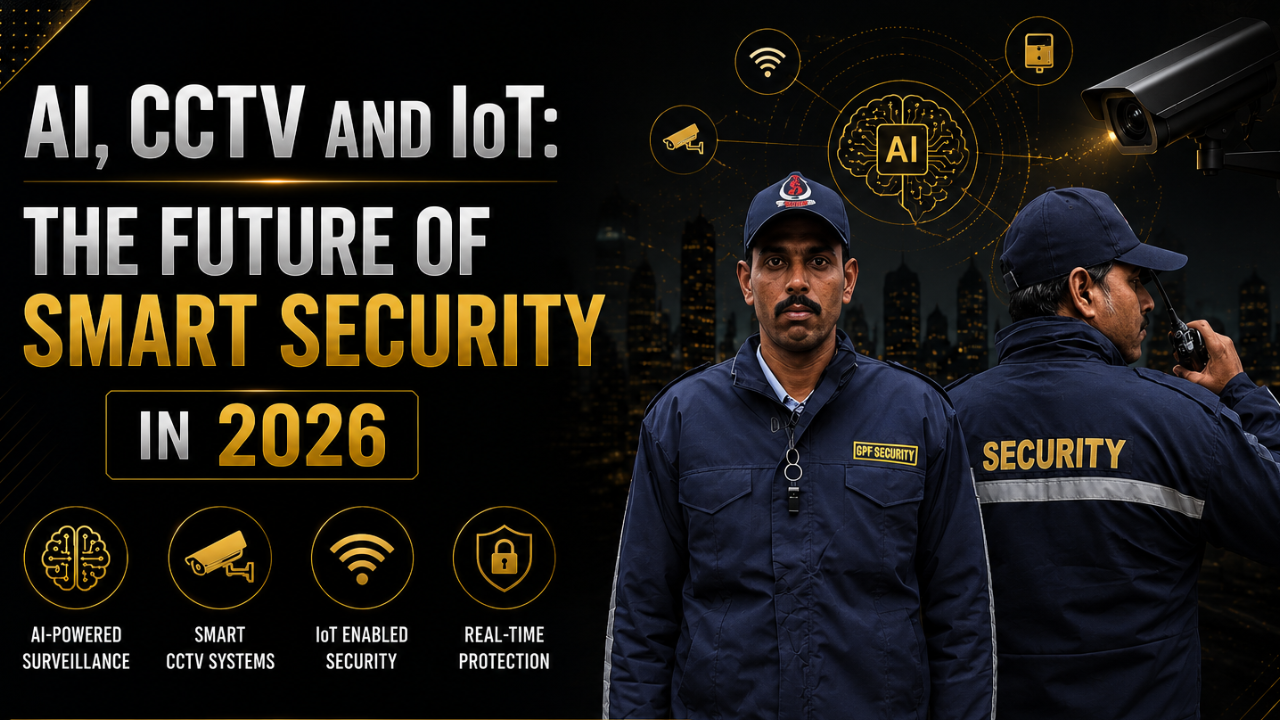
AI, CCTV, and IoT: The Future of Smart Security in 2026
Security is no longer just a guard at the gate and a camera in the corner. In 2026, the most protected offices, factories, and residential societies in Gurgaon and Delhi NCR run on smart security, a combination of trained guards backed by Artificial Intelligence (AI), connected CCTV, and Internet of Things (IoT) sensors that work together as one system.
This guide explains what smart security actually is, the technologies leading the change, how it compares to traditional security, and a simple step-by-step way for your business to upgrade.
What Is Smart Security? AI, CCTV, and IoT Explained
Smart security is the use of connected technology to detect, alert, and respond to threats faster and more accurately than people or cameras can on their own. Three layers make it work:
- AI (Artificial Intelligence): Software that "watches" camera feeds and sensor data, recognises patterns, and flags anything unusual, an unattended bag, a person in a restricted zone, a crowd forming, without a human staring at a screen all day.
- CCTV (Connected Cameras): Modern IP cameras are no longer just recording devices. Paired with AI video analytics, they can identify faces, read vehicle number plates, count people, and trigger alerts in real time.
- IoT (Internet of Things): A network of small connected devices, motion sensors, door contacts, smoke and gas detectors, and perimeter beams that constantly report their status to a central system, so nothing is left unmonitored.
On their own, each is useful. Together, they turn a building into a system that sees, understands, and reacts.
From the Field: What We Are Seeing Across Gurgaon and Delhi NCR
At Gurgaon Protection Force, we deploy and supervise security across offices in Cyber City and DLF, factories in Manesar, and large residential societies across Delhi NCR. Three clear shifts stand out in 2026:
- Detection is moving from "after the event" to "as it happens." Earlier, CCTV was reviewed after an incident. Now AI alerts a guard the moment something looks wrong, which changes the outcome entirely.
- Fewer blind spots. IoT sensors cover the places cameras miss, basements, rooftops, perimeter walls, store rooms, and report instantly if a door is forced or a sensor goes offline.
- Guards are becoming smarter, not fewer. The best results come when technology handles watching and alerting, and trained guards handle judgment and response. Technology rarely replaces people on the ground; it makes them far more effective.
7 Smart Security Technologies Changing the Game in 2026
- AI Video Analytics: Cameras that understand behaviour, loitering, intrusion, fighting, abandoned objects, and alert in real time.
- Facial Recognition & Access Control: Faster, contactless entry for staff and instant flags for unauthorised visitors.
- ANPR (Automatic Number Plate Recognition): Reads vehicle plates at gates and barriers for secure, logged entry and exit.
- IoT Perimeter & Environmental Sensors: Motion beams, door contacts, smoke, gas, and water-leak detectors that monitor 24/7.
- Smart Alarms & Instant Alerts: Threats trigger an immediate alert to the guard, supervisor, and control room at once.
- Centralised Command Centres: One dashboard that brings every camera, sensor, and alarm into a single live view.
- Drone & Robotic Patrol Support: Used for large campuses, warehouses, and industrial estates to cover ground quickly.
Traditional Security vs Smart Security: A Quick Comparison
- Coverage: Traditional security relies on fixed guard posts and recorded cameras. Smart security adds AI and sensors that watch every zone continuously.
- Detection speed: Traditional security often spots an incident after it happens. Smart security flags it the moment it begins.
- Accuracy: A guard watching many screens can miss things; AI does not get tired or distracted.
- Response: Traditional alerts depend on someone noticing. Smart security pushes instant alerts to guards, supervisors, and the control room together.
- Cost over time: Technology has an upfront cost, but it reduces incidents, theft, and manpower waste, which lowers total risk and cost over the long run.
- The key point: smart security does not replace guards. It gives trained guards better eyes, faster information, and the ability to act sooner. For a deeper look at this balance, see our guide on CCTV vs security guards for your business in Gurgaon.
How to Upgrade Your Business to Smart Security (Step by Step)
Step 1: Audit your current setup. Map every entry, exit, blind spot, and high-value area. Note where cameras and guards already exist and where the gaps are.
Step 2: Define your real risks. A residential society, an IT office, and a factory each face different threats. Prioritise the technology that solves your biggest risk first.
Step 3: Layer technology onto trained manpower. Add AI cameras and IoT sensors where they add the most value, but keep professional, PSARA-licensed guards at the core for response and judgement.
Step 4: Centralise monitoring. Bring all cameras, sensors, and alarms into one control room or dashboard so nothing is monitored in isolation.
Step 5: Train your guards on the technology. Smart security only works when the people using it are trained. Guard training is what turns an alert into the right action.
Step 6: Review and improve monthly. Track incidents, response times, and false alarms, and tune the system over time.
Our View: Technology Plus Trained People Wins
There is a lot of noise in 2026 about AI "replacing" security guards. In our experience across Gurgaon and Delhi NCR, that is not what works on the ground. The strongest security comes from technology and trained people working together, AI and IoT to detect and alert, and skilled, verified guards to respond and decide. A camera cannot stop an intruder or calm a situation. A guard supported by smart alerts can, and far faster than before.
Why Smart Security Matters for Gurgaon and Delhi NCR Businesses
Gurgaon and Delhi NCR are home to dense commercial hubs, large factories, and premium residential communities, all attractive, high-value, and fast-moving. Smart security gives these properties faster detection, fewer blind spots, stronger audit trails for compliance, and real peace of mind. Whether you run a corporate office, a manufacturing unit, or a housing society, the combination of AI, CCTV, IoT, and trained guards is quickly becoming the new standard, not a luxury.
Upgrade to Smart, Guard-Backed Security in Gurgaon & Delhi NCR
Gurgaon Protection Force is a PSARA-licensed, ISO 9001:2015-certified security and facility management company combining trained, police-verified guards with modern security technology across Gurgaon, Delhi, Noida, Faridabad, and Manesar since 2012.
Call +91 98210 40214 or request a free site assessment to see how smart security can protect your premises.
Upgrade to Smart, Guard-Backed Security in Gurgaon & Delhi NCR
Gurgaon Protection Force combines trained, police-verified guards with AI, CCTV, and IoT technology to protect offices, factories, and residential societies across Gurgaon, Cyber City, Manesar, Noida, Faridabad, and Delhi. PSARA-licensed and ISO 9001:2015 certified since 2012.
Frequently Asked Questions
What is smart security?
Smart security is the use of connected technology, AI, CCTV, and IoT sensors, working alongside trained guards to detect, alert, and respond to threats faster and more accurately than traditional security alone.
Will AI and CCTV replace security guards?
No. AI and CCTV are excellent at watching and detecting, but they cannot physically respond, use judgement, or handle a live situation. The best security in 2026 combines smart technology with trained, PSARA-licensed guards.
Is smart security worth the cost for businesses in Gurgaon?
Yes. While there is an upfront cost, smart security reduces incidents, theft, and blind spots, and strengthens compliance records, which lowers total risk and cost over time for offices, factories, and societies in Gurgaon and Delhi NCR.
What technologies are part of smart security?
Common technologies include AI video analytics, facial recognition, ANPR number-plate reading, IoT perimeter and environmental sensors, smart alarms, and centralised command-centre monitoring. See how technology compares to manpower in our guide on CCTV vs security guards.
How do I upgrade my building to smart security?
Start with an audit of your gaps and risks, layer AI cameras and IoT sensors onto a core of trained guards, centralise all monitoring into one dashboard, train your guards on the system, and review performance monthly. Request a free site assessment to get started.