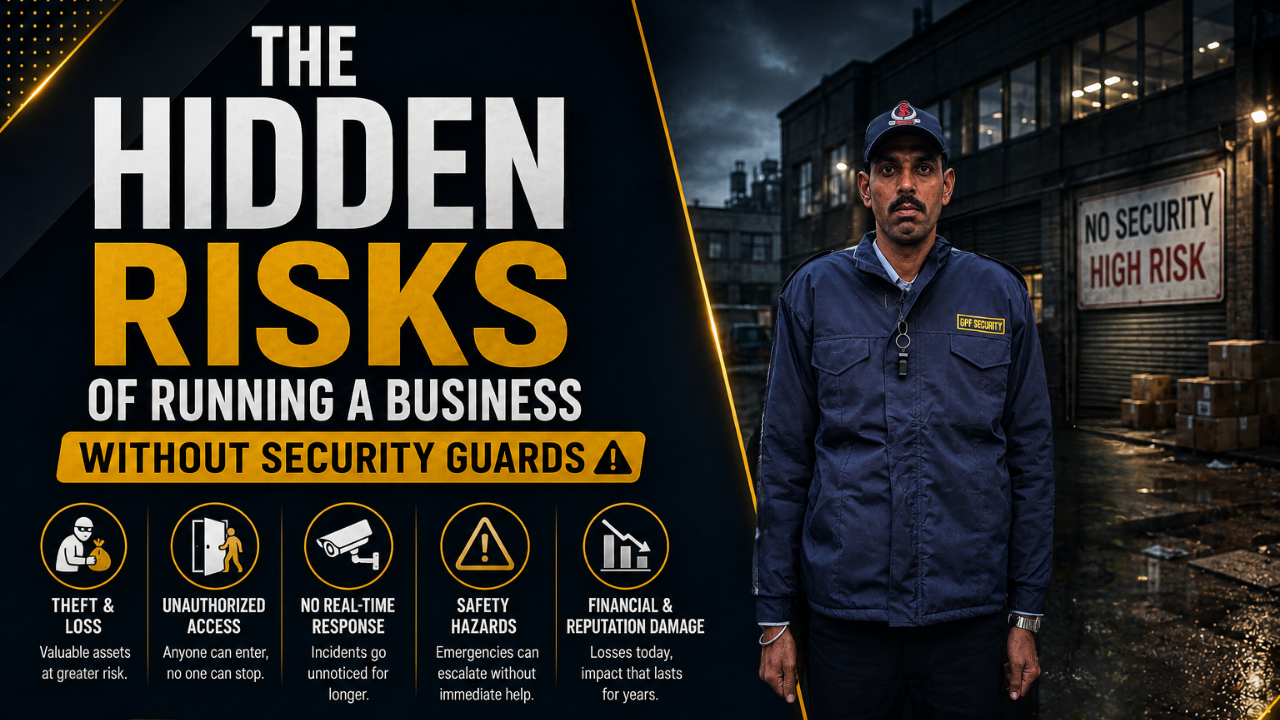
The Hidden Risks of Running a Business Without Security Guards
Security is often treated as an expense, right up until something goes wrong. A business may have CCTV cameras, access-control systems, alarms, and other technology in place, and still be exposed, because no camera can walk over and stop a problem.
For offices, warehouses, factories, retail stores, corporate buildings, and commercial properties, security guards provide a physical presence that technology alone cannot replace. They monitor the premises, control access, respond to unusual situations, assist employees and visitors, and help keep the environment calm and controlled. So what actually happens when a business has no security guards? The answer depends on the type of business and its risk profile, but a familiar set of problems tends to appear.
1. Unauthorised Access Becomes Easier
The first thing to slip is control over who comes in and who goes out. Without a guard at the entrance, a business leans entirely on access cards, biometrics, reception staff, or CCTV. Those tools are useful, but they do not always stop someone from tailgating an employee through a door, slipping in behind a vehicle, or wandering into an area they should never reach.
A trained guard verifies visitors, watches entry points, checks credentials, and directs authorised people to the right place, in real time.
2. Theft and Property Loss Can Rise
Every business holds something worth taking: equipment, inventory, documents, tools, electronics. Without a visible security presence, the opportunity for theft grows, especially in warehouses, construction sites, retail properties, and industrial units. Guards patrol regularly, watch for suspicious behaviour, check sensitive areas, and flag problems before they turn into losses.
3. CCTV Cannot Respond on Its Own
Cameras are a valuable part of modern security, but they mainly do two things: monitor and record. Someone still has to notice the suspicious activity and act on it. A guard can watch the feeds, investigate anything unusual, alert supervisors, and respond on the ground.
Technology can detect. People can assess and respond. The strongest security setups combine both.
4. Employees May Feel Less Safe
People spend a large part of their day at work. When there is no visible security presence, they can feel uneasy, particularly during early mornings, late evenings, or in isolated parts of a building. A guard gives employees a clear point of assistance when they face an unwanted visitor, a conflict, or an emergency, and that alone makes a workplace feel more controlled.
5. Visitor Management Gets Harder
Businesses see a steady stream of clients, vendors, delivery staff, contractors, and interview candidates. Without trained personnel at the entrance, that movement becomes hard to track. A security guard can:
- Verify visitor details and maintain visitor records
- Direct visitors to the correct department
- Monitor contractor movement
- Control delivery access
- Prevent entry into restricted areas
This matters most for corporate offices, factories, hospitals, residential societies, and large commercial facilities.
6. Emergency Response May Be Slower
When something unexpected happens, guards are often the first people on hand. That includes fire or smoke, medical emergencies, unauthorised entry, workplace conflicts, suspicious packages, property damage, and vehicle-related incidents.
A trained guard can raise the alarm, contact the right emergency service, guide people toward safety, and support the site's emergency procedures. They are not a replacement for the police, fire service, or medical professionals, but they provide valuable first-response support in the minutes that matter most.
7. Parking and Vehicle Movement Turns Chaotic
For offices, malls, factories, hospitals, societies, and commercial buildings, vehicle movement is its own security concern. Without personnel to manage it, you tend to see unauthorised parking, congestion at the gates, difficulty identifying visitors, delivery vehicles straying into restricted zones, and more disputes. Guards manage entry, verify permissions, guide drivers, and keep movement around the property orderly.
8. Night-Time Security Becomes a Weak Point
A business may go quiet after hours, but the property still needs protecting. Warehouses, factories, offices, construction sites, and commercial premises stay vulnerable through nights, weekends, and holidays. Regular patrols catch the things that would otherwise wait until Monday: an open door, a damaged fence, a water leak, or an equipment fault.
9. Incidents Can Go Unnoticed for Longer
The real advantage of having people on-site is continuous observation. A camera records an incident and an alarm signals a problem, but a guard can notice things that no automated system is set up to catch, such as:
- An unfamiliar vehicle repeatedly circling the property
- A damaged boundary wall
- An unlocked service entrance
- An employee entering a restricted area
- Suspicious activity near stored materials
- A safety issue quietly developing on-site
Spotting these early gives management more time to act.
10. Business Reputation Can Take a Hit
Security incidents cost more than money. If customers, employees, vendors, or visitors experience theft, unauthorised access, or a safety scare, their confidence in the business can drop. A professional security setup sends the opposite signal: that the organisation takes the safety of its people, visitors, and property seriously.
Security Guards Are More Than Gatekeepers
A common misconception is that a guard's only job is to stand at the gate. Modern security work covers far more:
- Access control: managing entry and exit
- Patrolling: scheduled inspections of the property
- Visitor management: recording and monitoring visitors
- Incident reporting: documenting unusual events and concerns
- Emergency support: supporting procedures and contacting authorities
- CCTV monitoring: observing surveillance systems where assigned
- Vehicle management: gates, parking, and vehicle movement
- Asset protection: helping protect equipment, inventory, and property
The exact responsibilities should always be defined around the specific site. For a full breakdown, see our security guard duties and responsibilities checklist.
Can Technology Replace Security Guards?
Technology has transformed the security industry, but it has not removed the need for trained people. CCTV, alarms, biometrics, access-control systems, and GPS tracking all strengthen a security operation, yet they work best when someone is there to interpret a situation and decide what to do next.
So for most businesses, the better question is not "guards or technology?" It is "how can trained guards and technology work together?" If you are weighing the two, our comparison of CCTV vs security guards walks through exactly where each one wins.
Which Businesses Actually Need Security Guards?
It depends on the property's size, location, assets, operating hours, visitor traffic, and risk profile. Guards are especially useful for corporate offices, industrial facilities, factories, warehouses, construction sites, retail stores, hospitals, hotels, residential societies, educational institutions, commercial complexes, and parking facilities.
A professional security assessment is the fastest way to work out how many guards you need, where to place them, how to structure shifts, and what each post should be responsible for.
Why Businesses Choose Professional Security Services
Hiring guards through a professional security company gives you a structured operation rather than just a person at a gate. A proper setup includes trained guards, supervisors, defined post responsibilities, shift management, reporting procedures, uniform standards, and ongoing monitoring.
For businesses in Gurgaon and Delhi NCR, Gurgaon Protection Force (GPF) provides professional security solutions built around the needs of different commercial and industrial environments.
Conclusion
A business without security guards is not automatically unsafe. But removing trained personnel opens up real gaps in access control, physical monitoring, visitor management, emergency response, and asset protection. Guards provide something technology cannot deliver on its own: a trained human presence that can observe, assess, communicate, and respond.
The goal is not simply to have someone standing at the gate. It is to build a planned, professional, and responsive security system that protects your business through the day and the night.
Not Sure How Many Guards Your Site Needs?
Gurgaon Protection Force provides trained, police-verified guards, supervisors, and 24/7 monitoring for offices, warehouses, factories, hospitals, and residential societies across Gurgaon, Noida, Faridabad, and Delhi. Start with a free site assessment. PSARA licensed and ISO 9001:2015 certified since 2012.
Frequently Asked Questions
What happens to a business with no security guards?
Without trained security personnel, a business faces greater challenges with unauthorised access, theft prevention, visitor management, emergency response, and night-time monitoring. CCTV and access-control technology help, but guards provide the human presence needed to notice situations and respond appropriately.
Can CCTV and alarms replace security guards?
Not fully. Cameras and alarms detect and record, but they cannot assess a situation, question a visitor, or physically respond. The strongest setups combine technology for detection with trained guards for assessment and response.
Which types of businesses need security guards the most?
Corporate offices, factories, warehouses, construction sites, retail stores, hospitals, hotels, residential societies, educational institutions, and commercial complexes benefit most, especially those with valuable assets, high visitor traffic, or extended operating hours.
How do I know how many security guards my site needs?
It depends on the property size, location, assets, operating hours, visitor traffic, and risk profile. A professional security assessment determines the number of guards, deployment locations, shift structure, and post responsibilities.
What does a professional security service include beyond a guard at the gate?
A professional setup includes trained guards, supervisors, defined post responsibilities, shift management, patrolling, visitor and vehicle management, incident reporting, CCTV monitoring where assigned, and ongoing supervision.