Hospital Security Services: A Complete Guide for Healthcare Facilities in Gurgaon
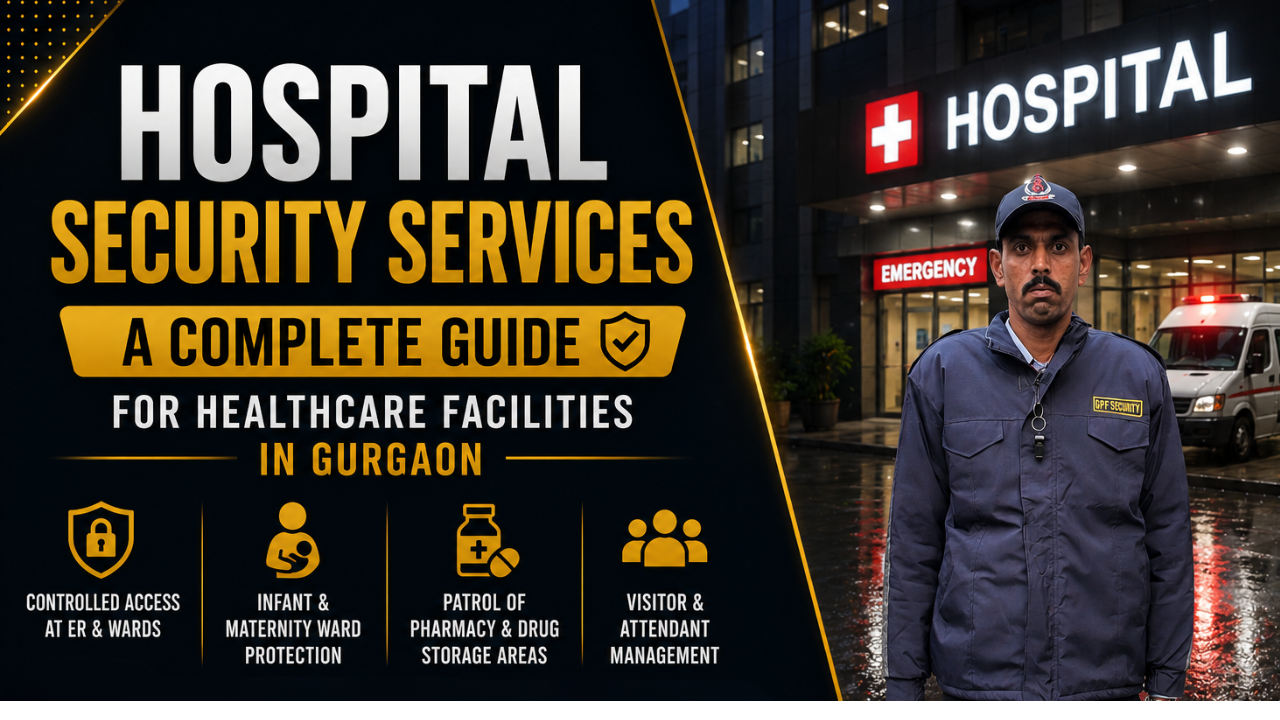
Quick answer: Hospital security services cover far more than a guard at the main gate. A proper healthcare security setup includes controlled access at the ER and wards, infant and maternity ward protection, patrol of pharmacy and drug storage areas, visitor and attendant management, parking and ambulance-bay control, and staff trained specifically to stay calm around patients, families, and medical emergencies, not just intruders.
Hospitals are one of the hardest places to secure. Unlike an office or a residential society, a hospital cannot simply lock its doors, it has to stay open to emergencies, visitors, and vendors around the clock, while still protecting patients, staff, medicines, equipment, and newborns from a very different set of risks than a typical commercial building faces.
Security in a hospital also has to deal with situations that rarely come up elsewhere, an agitated attendant in the ER at 2 AM, an unclaimed bag near the OPD, someone trying to walk out with a baby who is not theirs, or a scuffle between two families over a patient's condition. Generic guarding does not handle this well. Healthcare security guards need specific training, temperament, and protocols built around a hospital's actual risks.
Why Hospitals Need Specialised Security, Not Generic Guarding
A hospital security guard is dealing with grieving families, confused elderly patients, medical emergencies, and high-value equipment and drugs, often all in the same shift. The skill set is closer to crisis management than it is to standing at a gate.
What makes hospital security different
- 24x7 operation with no full lockdown possible, unlike an office that closes at night
- High footfall of visitors, attendants, and vendors who are strangers to each other and to staff
- Emotionally charged situations that can escalate quickly if handled poorly
- Protection of newborns and paediatric wards from unauthorised removal
- Controlled storage of narcotics, high-value drugs, and medical equipment
- Coordination with hospital staff, ambulance crews, and sometimes police, in real time
Where GPF fits: Our security guard services in Gurgaon include guards trained specifically for healthcare environments, on top of the standard PSARA-mandated training every GPF guard goes through.
Core Areas of Security in a Hospital
A healthcare facility is really several different security zones under one roof, each with its own risk profile. Treating the whole building as one uniform zone is where most gaps start.
1. Main Entrance & Reception
The first checkpoint for every visitor, attendant, and vendor. This is where bag checks, visitor passes, and ID verification for attendants should happen consistently, not only when the hospital feels busy.
2. Emergency Room (ER) & Trauma Ward
The single most volatile zone in any hospital. ER security needs guards who can de-escalate distressed families, manage crowd control during mass casualty events, and keep unauthorised people away from active treatment areas.
3. Maternity & Paediatric Wards
These require the strictest access control in the entire building, biometric or badge-based entry, visitor logs, and infant security protocols such as tagging and exit alarms to prevent unauthorised removal.
4. Pharmacy & Drug Storage
Narcotics and high-value medicines need controlled access, CCTV coverage, and regular patrol, since these areas are a target for both external theft and internal pilferage.
5. Parking & Ambulance Bay
Needs clear lane discipline for ambulances at all times, vehicle logging, and guards positioned to prevent the ambulance bay from being blocked during an actual emergency.
6. General Wards & ICU
Requires visitor-hour enforcement, attendant passes, and quiet but visible patrolling that does not disturb recovering patients.
| Zone | Primary Risk | Security Measure |
|---|---|---|
| Main Entrance | Unverified visitors, theft | ID checks, visitor passes, bag screening |
| Emergency Room | Crowd control, aggression | Trained de-escalation staff, restricted access |
| Maternity/Paediatric | Infant abduction | Biometric access, tagging, exit alarms |
| Pharmacy | Drug theft | CCTV, controlled entry, patrol logs |
| Parking/Ambulance Bay | Blocked access during emergencies | Lane discipline, vehicle logging |
| ICU/General Wards | Unauthorised visitors | Visitor-hour enforcement, attendant passes |
Types of Healthcare Security Guards a Hospital Needs
Most hospitals need a mix of guard types rather than one uniform security force, deployed by zone and shift based on actual risk.
- Unarmed static guards at entrances, wards, and reception for access control and visitor management
- Armed guards for high-value pharmacy stores or facilities in higher-risk locations
- Women security staff for maternity wards and female patient areas, where they are often required and preferred
- Security supervisors to coordinate shifts, handle escalations, and liaise with hospital administration
- CCTV control room operators to monitor corridors, entrances, and drug storage in real time
Where GPF fits: We deploy a mix of trained guards for healthcare clients depending on the zone, including armed guard services for high-value areas and security supervisors to manage shift-wise coordination across a large facility. For added coverage in high-risk zones, our CCTV vs security guards comparison explains where cameras and manned guarding work best together.
Hospital Security Guard Duties Checklist
These are the core duties every guard posted in a healthcare facility should be following on every shift:
- Verify ID and issue passes for every visitor and attendant, not just during peak hours
- Enforce visiting hours in ICU and general wards
- Patrol pharmacy, drug storage, and equipment rooms on a fixed schedule
- Monitor maternity ward entry and exit points continuously
- Keep the ambulance bay and emergency entrance clear at all times
- Log every incident, from a lost item to an altercation, in the shift report
- Coordinate calmly with hospital staff during emergencies rather than adding to the chaos
- Escalate to the supervisor and hospital administration immediately for any serious incident
Where GPF fits: This checklist is adapted from our broader security guard duties and responsibilities checklist, customised for the specific risks a hospital or clinic faces.
Why Verified, Trained Guards Matter More in Healthcare
A hospital cannot afford a guard who is untrained, unverified, or unreliable, the stakes involve patient safety, infant security, and controlled substances, not just property. This is exactly why background verification and licensing are non-negotiable in this sector.
Example: A multi-specialty hospital in Gurgaon reduced attendant-related disturbances in its ER by nearly half after introducing strict visitor passes and stationing a trained supervisor on every shift to handle escalations before they reached the treatment area.
Where GPF fits: Every guard we deploy, including for healthcare clients, goes through police verification, identity checks, and medical screening before their first shift. You can read more about how this works on our regulatory compliance page and in our guide on the benefits of hiring a PSARA-licensed security agency.
Choosing a Hospital Security Services Provider
Not every security agency is equipped to handle a healthcare facility. Before signing a contract, hospitals and clinics should confirm the provider can offer:
- PSARA licensing and documented guard verification
- Guards specifically briefed on healthcare protocols, not generic instructions
- Availability of women security staff for maternity and female wards
- 24x7 supervisor coverage and a clear escalation matrix
- Experience managing at least one other healthcare client, ideally verifiable
For a broader view of what to check before signing with any provider, see our guide on choosing the best security agency in Gurgaon.
Conclusion
Security in a hospital is not a smaller version of office security, it is a different discipline built around emergencies, vulnerable patients, and round-the-clock access that can never fully shut down. Getting it right means the right mix of trained guards, zone-specific protocols, and constant coordination with hospital staff, not just a uniform at the front gate.
If your facility needs security built around actual healthcare risk zones rather than a standard commercial template, GPF's corporate and institutional security teams can be customised specifically for hospitals, clinics, and diagnostic centres across Gurgaon and Delhi NCR.
Protect Your Patients, Staff, and Facility
Gurgaon Protection Force provides trained, police-verified healthcare security guards, including women staff for maternity wards, armed guards for high-value zones, and 24x7 supervisor coverage, for hospitals, clinics, and diagnostic centres across Gurgaon, Noida, Faridabad, and Delhi. PSARA licensed and ISO 9001:2015 certified since 2012.
Frequently Asked Questions
What is included in hospital security services?
Hospital security services typically include access control at entrances and wards, visitor and attendant verification, ER crowd management, maternity ward and infant protection, pharmacy and drug storage patrol, ambulance bay monitoring, and CCTV surveillance, delivered by guards trained specifically for healthcare environments.
Why do hospitals need specialised security guards instead of regular guards?
Hospitals deal with emotionally charged situations, vulnerable patients, newborns, and controlled substances that generic guarding is not trained to handle. Healthcare security guards need skills in de-escalation, visitor management, and coordination with medical staff that a standard commercial guard typically does not have.
What are the main duties of a security guard in a hospital?
Core duties include verifying visitor and attendant IDs, enforcing visiting hours, patrolling pharmacy and drug storage areas, monitoring maternity ward access, keeping the ambulance bay clear, logging incidents, and escalating serious situations to supervisors and hospital administration immediately.
Do hospitals need women security guards?
Most hospitals require or strongly prefer women security staff for maternity wards, female patient areas, and situations involving female patients or attendants, both for comfort and for compliance with hospital protocol.
How is hospital security different from corporate office security?
Corporate security generally manages a controlled, predictable environment with defined working hours. Hospital security operates 24x7 without full lockdown, deals with medical emergencies and vulnerable patients, and requires zone-specific protocols for areas like the ER, pharmacy, and maternity ward that offices simply do not have.