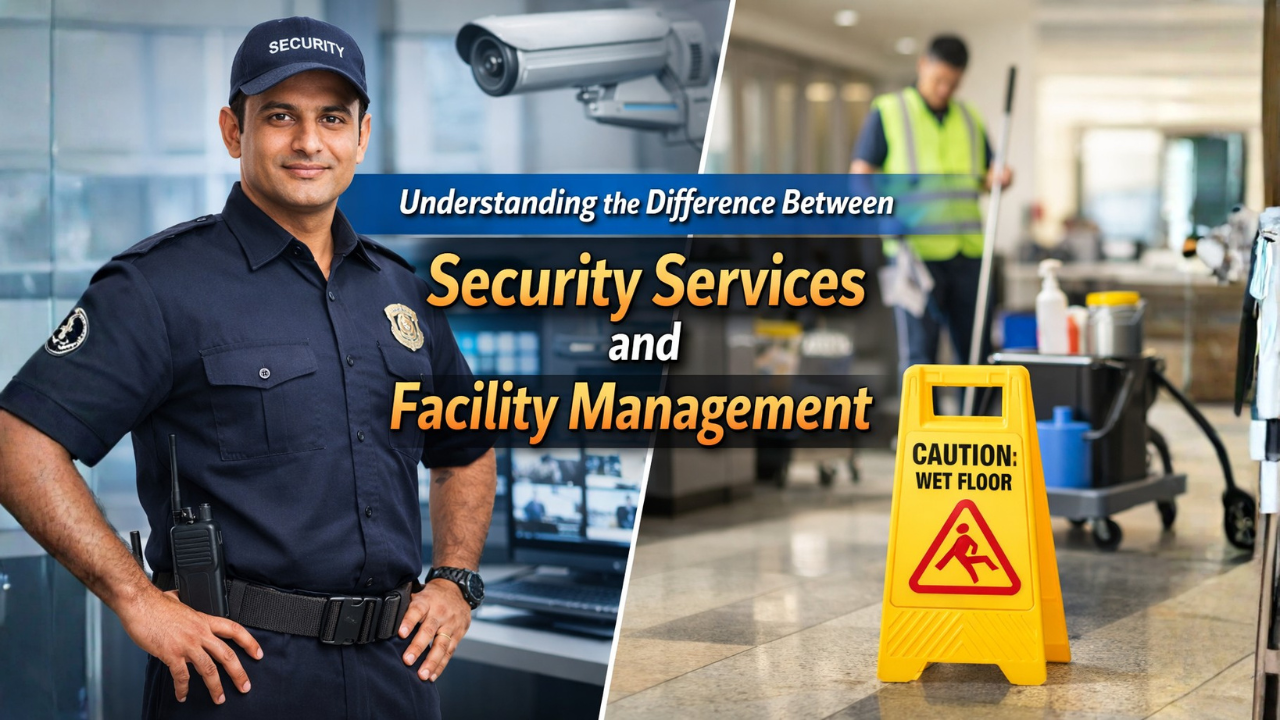
Understanding the Difference Between Security Services and Facility Management
Many people use the terms security services and facility management together, but they are not the same. Both services are important for offices, commercial buildings, factories, residential societies and malls, but their roles are different. Understanding this difference helps businesses choose the right services and manage their workplaces in a better and more organised way.
Let’s explain this difference simply and practically, so it is easy to understand for everyone.
What Are Security Services
Security services are mainly responsible for protecting people, property, and assets from risks and threats. The primary objective of security services is prevention, control, and quick response. Security guards are usually the most visible part of this service and are positioned at entry and exit points, reception areas, parking zones, and other sensitive locations within a property.
Security personnel manage visitor entry by checking identification, maintaining visitor records, and ensuring that only authorised individuals are allowed inside the premises. They also conduct regular patrolling across the site to monitor activities and identify anything unusual. CCTV monitoring is another important responsibility, where guards continuously observe camera feeds to maintain surveillance.
In emergencies such as theft attempts, fire incidents, medical emergencies, or conflicts, the security team acts as the first responder. They control the situation, guide people to safety, and coordinate with police, fire, or medical services when required. Security services also help maintain discipline and order, especially in large workplaces with heavy movement of people.
In simple terms, security services focus on safety, protection, and risk prevention, creating a secure and controlled environment for employees, visitors, and clients.
What Is Facility Management
Facility management focuses on the smooth functioning and maintenance of a building or workplace. While security services protect people and assets, facility management ensures that the working environment remains clean, comfortable, and fully operational at all times. Facility management covers a wide range of activities that support daily business operations.
This includes housekeeping services that keep offices, washrooms, and common areas clean and hygienic. Facility management also looks after electrical systems, plumbing, lighting, elevators, air conditioning, and ventilation. Whenever equipment breaks down or repairs are required, the facility team takes responsibility to minimize disruption to work.
Apart from maintenance, facility management also includes pantry services office support staff, vendor coordination, and regular inspections. The facility team ensures that all service providers perform their duties properly and that safety and compliance standards are followed.
Most of the time, facility management teams work quietly in the background. However, their importance becomes very clear when systems fail or maintenance is poor. A well-managed facility allows employees to focus on their work without distractions caused by infrastructure or service issues.
In simple words, facility management is about maintenance, comfort, and smooth daily operations.
Core Difference Between Security Services and Facility Management
Although both services support workplaces, their focus areas are different.
| Security Services | Facility Management |
|---|---|
| Focus on safety and protection | Focus on maintenance and operations |
| Managed by trained security guards | Managed by technical and support staff |
| Controls entry, exit, and access | Manages infrastructure and services |
| Handles emergencies and risks | Handles breakdowns and repairs |
| Prevents theft and threats | Prevents discomfort and downtime |
Both are essential, but they serve different purposes.
How Security Services and Facility Management Work Together
Even though security services and facility management have different responsibilities, they work best when coordinated. During regular patrolling, security guards may identify safety concerns such as broken lights, damaged doors or unsafe areas. These observations are then shared with the facility management team, which takes corrective action.
During emergencies, security teams focus on managing people, controlling panic, and ensuring safety, while facility teams handle technical support such as power shutdowns, fire systems or equipment repairs. This coordination helps resolve issues faster and prevents confusion during critical situations.
When both teams communicate effectively, the workplace becomes safer, more organised, and easier to manage.
Why Businesses Need Both Services
A workplace that is well maintained but lacks security can be unsafe, while a secure workplace with poor maintenance can be uncomfortable and inefficient. This is why businesses need both security services and facility management. When both services work properly, employees feel safe, productivity improves, and daily operations run smoothly. Together, these services create a balanced and well managed working environment.
Integrated Facility Management: The Smart Solution
Many organisations now opt for Integrated Facility Management (IFM). This means security services and facility management are handled by one professional service provider.
Benefits of Integrated Facility Management
- Better coordination between teams
- Faster problem resolution
- Cost control and transparency
- Single point of contact
- Consistent service quality
For large offices, IT parks, factories, and commercial buildings, integrated services reduce confusion and improve efficiency.
Real Life Example for Better Understanding
Imagine a corporate office building:
- Security services control who enters the building, monitor CCTV cameras, and respond to emergencies.
- Facility management ensures elevators work, washrooms are clean, air conditioning runs properly, and electrical systems are maintained.
Both teams have different roles, but together they keep the building safe, functional, and comfortable.
How to Choose the Right Service Provider
Selecting the right security and facility management partner is a critical decision. Businesses should look for experience, trained manpower, proper supervision, and a strong local presence. A reliable service provider understands the local working environment and can respond quickly during emergencies.
Transparency, regular reporting, and continuous improvement are also important factors. A good service partner does not just provide manpower but works as a support system for the business.
Choosing the right partner ensures long term stability, safety, and peace of mind.
Conclusion
Security services and facility management are not the same, but both are equally important for a well managed workplace. Security services protect people and property, while facility management ensures comfort, cleanliness, and smooth daily operations.
Businesses that understand this difference can make smarter decisions, reduce risks, and create safer, more productive environments for employees and visitors.
Choosing the right balance or a trusted partner that offers both helps organisations operate without stress and interruptions.
Frequently Asked Questions (FAQs)
Are security services part of facility management?
They are different services, but they can be offered together under integrated facility management for better coordination.
What is the main role of security services?
Security services focus on safety, access control, surveillance, and handling emergencies.
What does facility management mainly handle?
Facility management handles cleaning, maintenance, repairs, vendor management, and daily operational support.
Do small offices need both services?
Yes. Even small offices benefit from basic security and facility management to ensure safety and smooth operations.
What are the benefits of integrated facility management?
It offers better coordination, cost efficiency, faster response, and simplified management through one service provider.