
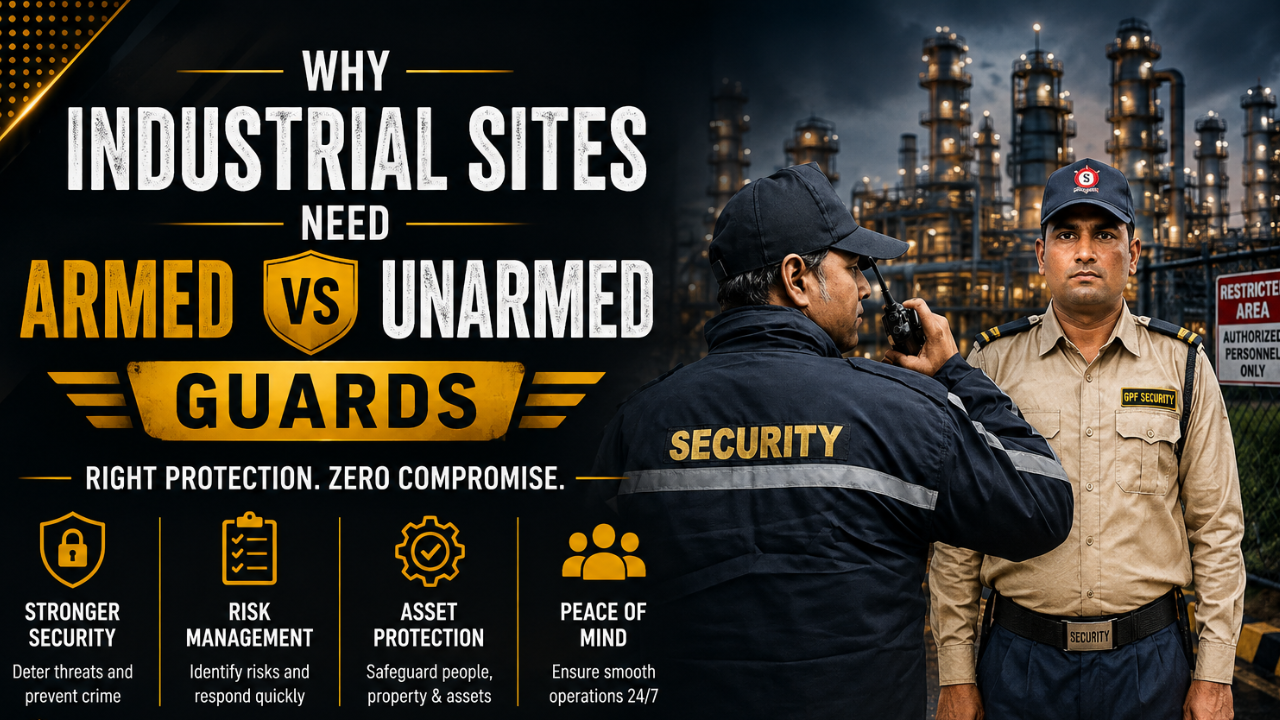
Why Industrial Sites Need Armed vs Unarmed Guards
Quick answer: Most industrial sites in Gurgaon run fine on trained unarmed guards for gate control, patrol, and visitor management. Armed guards become necessary when a site holds high-value inventory, hazardous materials, cash, or sits in a higher-risk location, since the deterrent and response capability of an armed presence is different from a standard guard. Most factories actually need a mix of both, not an all-or-nothing choice.
Every industrial or manufacturing site owner eventually asks the same question: do we need armed guards, or are trained unarmed guards enough? The honest answer is that it depends on what is inside the gate, not on how the site looks from the outside. A warehouse full of consumer electronics has a very different risk profile from a bottling plant, and both are different from a chemical storage facility.
Getting this decision wrong in either direction costs money. Over-securing a low-risk site with armed guards adds unnecessary cost and licensing overhead. Under-securing a high-value site with only unarmed staff leaves a real gap that shows up the first time something goes wrong. Below is how to actually think through this decision for a factory, warehouse, or industrial plant in Gurgaon and NCR.
What Unarmed Guards Actually Cover
Unarmed security guards are the backbone of most industrial security setups, and they cover more ground than people assume.
Core responsibilities of unarmed industrial guards
- Gate control and vehicle/visitor logging at entry and exit points
- Perimeter patrol on a fixed schedule to catch breaches early
- Checking outgoing material against gate passes to prevent pilferage
- Monitoring loading and unloading bays
- Coordinating with CCTV control rooms and reporting anomalies
- First response to fire alarms, equipment issues, or minor incidents
Where GPF fits: This is the standard scope covered by our security guard services in Gurgaon, and it is sufficient for the large majority of industrial sites we manage, offices, standard warehousing, and light manufacturing units included.
When a Site Actually Needs Armed Guards
Armed guards are not about looking more serious, they are for sites where the value or nature of what is being protected genuinely changes the risk calculation.
Situations where armed guards make sense
- High-value inventory, precious metals, electronics, or bulk cash on site
- Storage of hazardous, flammable, or controlled materials
- Facilities in isolated locations with limited police response time
- Sites that have faced armed robbery attempts or credible threats before
- Large industrial complexes where perimeter length makes rapid response difficult with unarmed staff alone
- Client or insurance requirements that specifically mandate armed coverage
Example: A bulk cash-handling facility in Manesar moved from unarmed to a mixed armed-unarmed deployment after an insurance audit flagged the value of on-site cash reserves as exceeding the threshold for standard guarding alone.
Where GPF fits: Our armed guard services in Gurgaon are deployed specifically for these higher-risk profiles, always alongside proper licensing and documented threat assessment, not as a default upsell.
Armed vs Unarmed: A Side-by-Side Comparison
| Factor | Unarmed Guards | Armed Guards |
|---|---|---|
| Best For | Standard warehousing, light manufacturing, offices | High-value inventory, cash handling, hazardous materials |
| Licensing | Standard PSARA registration | Additional arms licensing and stricter background checks |
| Cost | Lower, standard guarding rates | Higher, due to licensing, training, and liability |
| Deterrent Level | Moderate, visible presence and access control | High, for genuine high-risk exposure |
| Typical Deployment | Gates, perimeter, patrol, loading bays | Cash rooms, high-value stores, isolated perimeters |
Why Most Industrial Sites Actually Need a Mixed Model
In practice, very few factories are purely low-risk or purely high-risk everywhere. A typical industrial site might have a low-risk shop floor and a high-value raw material store in the same compound. Treating the whole site the same way, all armed or all unarmed, usually means either overspending or leaving a real gap.
A mixed deployment puts unarmed guards at general gates and patrol routes, and armed guards specifically at the zones that carry genuine risk, cash rooms, controlled substance storage, or isolated perimeter sections. This is also where a security supervisor becomes essential, someone has to coordinate both guard types across shifts and make sure the higher-risk zones are never left uncovered during a shift change.
Where GPF fits: Our teams routinely run mixed deployments for manufacturing clients, unarmed staff on general gates and patrol, armed guards at flagged high-value zones, all coordinated by a single on-site supervisor. See how CCTV can extend this coverage further in our guide on CCTV vs security guards.
How to Actually Assess What Your Site Needs
Before deciding, walk through these questions honestly rather than defaulting to whatever the last vendor recommended:
- What is the total value of inventory, equipment, or cash on site at any given time?
- Does the site store anything hazardous, flammable, or controlled by law?
- How far is the nearest police response point, and what is the realistic response time?
- Has the site faced any theft, break-in, or armed threat in the past three years?
- How long is the perimeter, and can unarmed patrol realistically cover it within a shift?
- Do your insurance or client contracts specify a minimum security standard?
Where GPF fits: We run a site risk assessment before recommending armed, unarmed, or mixed deployment, the same process outlined in our broader security guard duties and responsibilities checklist, adapted for industrial risk factors.
Licensing and Compliance Matter More With Armed Guards
Armed guarding in India comes with significantly stricter compliance requirements than standard unarmed guarding, arms licensing, additional background verification, and tighter documentation. Any agency offering armed guards without being able to show this paperwork on request should be treated as a serious red flag, not a cost-saving option.
Where GPF fits: Every armed deployment is backed by documented licensing and verification under our regulatory compliance standards. You can also read more on why licensing matters across all guard types in our guide on the benefits of hiring a PSARA-licensed security agency.
Choosing the Right Provider for Industrial Security
Not every security agency is set up to run armed deployments correctly. Before signing a contract for an industrial site, confirm the provider can show:
- Valid PSARA license and, where applicable, arms licensing documentation
- A documented risk assessment process, not a flat recommendation regardless of site
- Experience running mixed armed-unarmed deployments, not just one or the other
- On-site supervision across all shifts, not just daytime coverage
For a broader checklist on vetting any security provider, see our guide on choosing the best security agency in Gurgaon.
Conclusion
Armed versus unarmed is not really a single decision, it is a zone-by-zone assessment based on what is actually at risk inside your site. Most industrial facilities run safely on well-trained unarmed guards, with armed coverage reserved for the specific areas that genuinely carry higher value or risk. Getting this mix right protects the site without overspending on unnecessary armed deployment everywhere.
If you are unsure which zones of your facility actually need armed coverage, GPF can run a site assessment and recommend a deployment mix as part of our broader industrial and corporate security services across Gurgaon and Delhi NCR.
Not Sure Which Zones Need Armed Coverage?
Gurgaon Protection Force runs on-site risk assessments for factories, warehouses, and industrial plants, then deploys the right mix of armed and unarmed guards for each zone. PSARA licensed and ISO 9001:2015 certified since 2012.
Frequently Asked Questions
Do all industrial sites need armed guards?
No. Most industrial sites, standard warehousing, and light manufacturing units run safely on trained unarmed guards. Armed guards are recommended specifically for sites with high-value inventory, cash handling, hazardous materials, or elevated threat history.
Can a factory use both armed and unarmed guards together?
Yes, and it is often the most cost-effective approach. Unarmed guards typically cover general gates and patrol routes, while armed guards are placed specifically at high-value or high-risk zones, coordinated by a single on-site supervisor.
What licensing is required for armed guards in India?
Armed guards require standard PSARA registration plus additional arms licensing and stricter background verification compared to unarmed guards. Any agency deploying armed guards should be able to show this documentation on request.
How do I know if my warehouse needs armed security?
Assess the value of on-site inventory or cash, whether hazardous materials are stored, distance from police response, past incidents, and perimeter length. If several of these point to elevated risk, armed coverage for the specific high-risk zones is worth considering.
Is armed security more expensive than unarmed guarding?
Yes, armed guards typically cost more due to licensing, specialised training, and liability considerations. This is why a mixed deployment, armed only where genuinely needed, is usually more cost-effective than an all-armed or all-unarmed approach.