
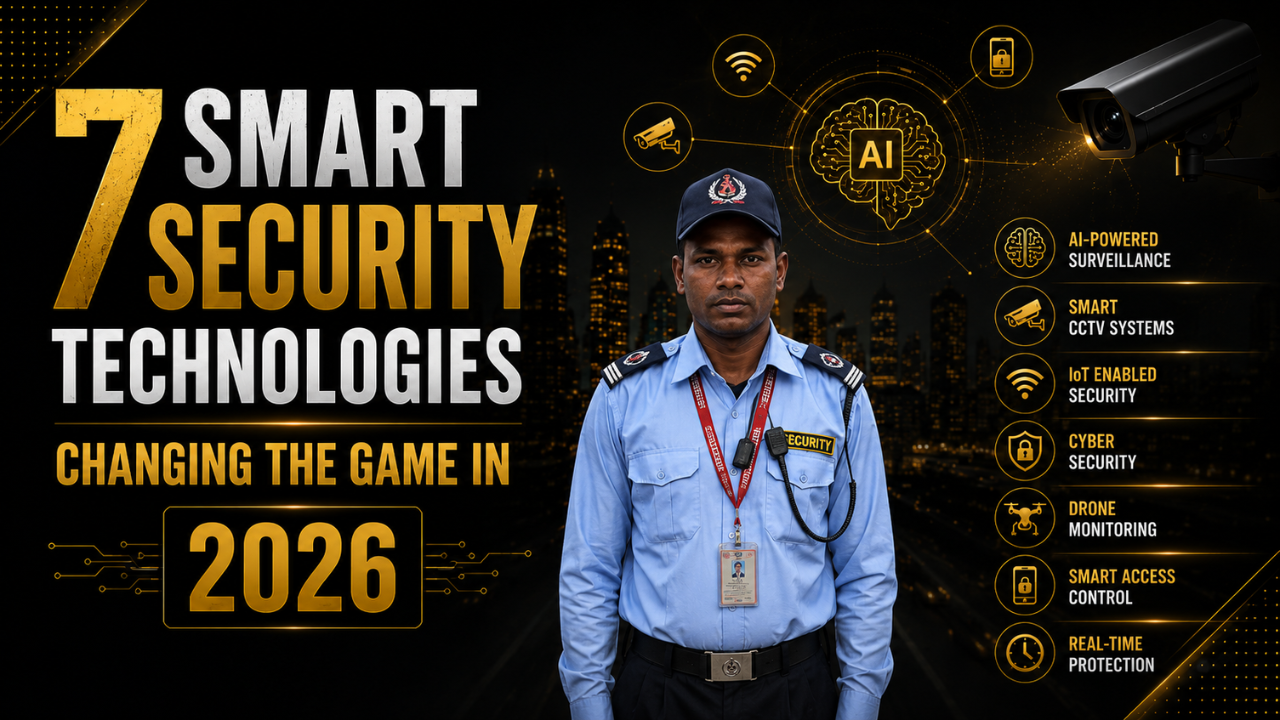
7 Smart Security Technologies Changing the Game in 2026
Security in 2026 is no longer about a single guard and a recording camera. It is a connected system where technology detects, trained people decide, and both work together in real time. Across our deployments in Cyber City, DLF, Manesar, and residential societies throughout Delhi-NCR, we have seen security shift from reviewing footage after an incident to being alerted the moment something appears wrong.
Here are the seven smart security technologies making the biggest difference this year, and exactly where each one fits.
1. AI Video Analytics
What it is: Software that reads live camera feeds and understands what it is seeing, loitering, intrusion into a restricted zone, a fight, or an abandoned bag, and then alerts a guard instantly instead of waiting for someone to notice.
Why it matters: A guard watching a wall of screens will eventually miss something. AI does not get tired or distracted, so nothing slips through during the quiet hours when incidents actually happen.
Best for: large offices, warehouses, and gated societies.
2. Facial Recognition and Access Control
What it is: Contactless entry that recognises staff and residents in a second, logs every entry and exit, and flags anyone who is not authorised to be inside.
Why it matters: It removes the weak points of keys, cards, and paper registers, and gives you a clean, searchable record of exactly who entered and when, which is invaluable during any investigation.
Best for: corporate offices, data centres, and premium residences.
3. ANPR (Automatic Number Plate Recognition)
What it is: Cameras at gates and barriers that read vehicle number plates automatically, opening boom barriers for approved vehicles and logging every plate that enters or leaves.
Why it matters: It eliminates manual gate registers and long queues at entry points while creating an accurate vehicle trail for societies, factories, and corporate parks.
Best for: residential societies, industrial estates, and office parks.
4. IoT Perimeter and Environmental Sensors
What it is: A network of small connected devices, motion beams, door contacts, and smoke, gas, and water-leak detectors, that constantly report their status to a central system.
Why it matters: Sensors cover the blind spots cameras miss, basements, rooftops, perimeter walls, and store rooms, and raise an instant alert if a door is forced or a device goes offline.
Best for: factories, warehouses, and large campuses.
5. Smart Alarms and Instant Alerts
What it is: A system where any confirmed threat triggers an immediate alert to the guard on site, the supervisor, and the control room, all at the same moment.
Why it matters: Traditional alerts depend on one person noticing and then calling someone. Smart alerts compress that delay to seconds, which is often the difference between a stopped incident and a real loss.
Best for: every site that values response speed.
6. Centralised Command Centres
What it is: One dashboard that brings every camera, sensor, and alarm across a site, or across many sites, into a single live view monitored around the clock.
Why it matters: Security fails when things are watched in isolation. A command centre gives supervisors the full picture, faster decisions, and a single source of truth for reporting.
Best for: multi-site businesses, large societies, and corporates.
7. Drone and Robotic Patrol Support
What it is: Drones and robotic patrol units that cover large open areas quickly, reaching perimeters and rooftops that would take a guard on foot far longer to check.
Why it matters: On sprawling industrial estates and warehouses, they extend how much ground a single team can cover, without adding blind spots.
Best for: industrial estates, warehouses, and large campuses.
How to Choose the Right Mix for Your Property
You rarely need all seven at once. The right combination depends on your biggest risk. A residential society usually starts with ANPR at the gate and IoT perimeter sensors. A corporate office prioritises facial-recognition access control and AI video analytics. A factory leans on sensors, a command centre, and patrol support.
Start with a simple audit: map your entries, exits, blind spots, and high-value areas, then add technology where it removes the most risk first. For a deeper look at how technology and manpower compare, see our guide on CCTV vs security guards for your business in Gurgaon.
Technology Plus Trained Guards Wins
The point most people miss is that none of these technologies replace guards. They make trained, police-verified guards far more effective by giving them better eyes and faster information. A camera cannot stop an intruder or calm a situation, but a guard supported by smart alerts can, and much sooner than before. For the bigger picture on where all of this is heading, read our companion guide, AI, CCTV and IoT: The Future of Smart Security in 2026.
Why This Matters for Gurgaon and Delhi NCR Businesses
Gurgaon and Delhi NCR are home to dense commercial hubs, large factories, and premium residential communities, all attractive, high-value, and fast-moving. The right smart security mix gives these properties faster detection, fewer blind spots, and stronger audit trails for compliance. Whether you run a corporate office, a manufacturing unit, or a housing society, combining these technologies with trained guards is quickly becoming the new standard, not a luxury.
Bring Smart, Guard-Backed Security to Your Premises
Gurgaon Protection Force combines trained, police-verified guards with AI, CCTV, and IoT technology to protect offices, factories, and residential societies across Gurgaon, Cyber City, Manesar, Noida, Faridabad, and Delhi. PSARA-licensed and ISO 9001:2015 certified since 2012.
Frequently Asked Questions
What are smart security technologies?
Smart security technologies are connected tools, such as AI video analytics, facial recognition, ANPR, IoT sensors, smart alarms, command centres, and drones, that detect and alert on threats faster and more accurately than traditional cameras and guards working alone.
Do smart security technologies replace security guards?
No. These technologies detect and alert, but they cannot physically respond or use judgement. The strongest security in 2026 combines smart technology with trained, PSARA-licensed guards who respond and decide.
Which smart security technology should a residential society start with?
Most societies begin with ANPR at the main gate and IoT perimeter sensors, then add AI video analytics and a monitoring dashboard as needs grow. The right starting point depends on your biggest risk and layout.
Are smart security systems worth it for businesses in Gurgaon?
Yes. While there is an upfront cost, smart security reduces incidents, theft, and blind spots, and strengthens compliance records, which lowers total risk and cost over time for offices, factories, and societies in Gurgaon and Delhi NCR.
Can Gurgaon Protection Force install and manage smart security?
Yes. Gurgaon Protection Force is a PSARA-licensed, ISO 9001:2015 certified agency that combines trained, police-verified guards with modern security technology across Gurgaon and Delhi NCR. Request a free site assessment to get started.